Posted in Book Reviews

Two Tips and an Announcement

I’ve got two tips and an announcement in this post. First, the announcement.

After eleven years, I’ve decided to stop blogging. In retrospect, it’s past time. I’ll explain why in my last post.

The last post could be my longest ever. I plan to discuss the evolution of my views of Mississippi litigation. I view things a lot differently than I did eleven years ago. I will explore why in the last post.

It will take me a while to organize my thoughts and get it on paper. My goal is to publish the last post on March 2, but I may grant myself and extension.

The two tips are:

  1. install Sanebox email management to gain control over your inbox; and
  2. read the book The Algebra of Happiness by Scott Galloway. It’s my new favorite book and the first paragraph in the first (non-introduction) chapter is the best summary for how life changes between 25 and 45 I’ve ever read. I wish I could have read it when I was 25 or 30.
Twitter
Facebook
Email
LinkedIn

Book Review: The Nonsense Factory, by Bruce Cannon Gibney

The Nonsense Factory by Bruce Cannon Gibney is a scathing critique of the American Legal System. A venture capitalist and former big firm litigator, Gibney knows his subject.

There is a lot to criticize in the legal system starting with law school, and Gibney touches on most of it. His criticism of law schools is pointed, but in a funny way:

American law schools have settled for the worst of all worlds–an abstracted research faculty presiding over an outmoded trade school. The results have not been good….Many students flub the bar exam and will never practice law, while the rest require years of expertise before they can produce competent work on their own….American law schools, then, are something of a bust.

Many students, even from relatively good schools. fail the bar exam–a test for which law school does not really prepare them…Naturally, people who should fail do fail. But some people who should pass also fail….

What is consequential is that the bottom half of law schools routinely admit battalions of students who will not thrive…

new lawyers face troubling levels of unemployment.

Gibney does not stop with law schools. He also criticizes the lack of formal judicial training:

one federal appointee, lacking trial experience, was confounded by routine oral motions, scurrying back to chambers to research basic questions that a trained judge could handle automatically; another recently appointed judge in California has been known to solicit advice from colleagues via text message in open court.

There is a chapter on mandatory arbitration, which Gibney criticizes as catastrophic for employees and consumers. But he does a good job explaining not all arbitration is bad:

arbitration arose to serve specific purposes and remains a fair and useful mechanism for the kinds of disputes that occasioned its invention.

It’s clear Gibney worked in a big law firm when he discusses hourly rates and legal fees:

Clients might accept the risk of minor imperfections, but lawyers won’t and can’t. For junior lawyers, a mere typo can be a source of profound embarrassment, while a substantive mistake is seen as a potentially career-ending disaster….Opponents will gleefully exploit any blunder, and law’s adversarial culture is so deeply entrenched that even senior partners revel in exposing mistakes made by their own teams, however trivial.

Unfortunately, this is 100% true. I also suspect it has spilled into the judiciary as lawyers who worked in this culture became judges.

Much more than when I began practicing in the early 90’s, litigation has become an exercise in dodging trap doors that allow cases to be decided on issues other than the merits. While most of these trap doors–such as pre-suit notice requirements–apply to plaintiffs, many also apply to defendants. Too many cases are decided based on what happens during litigation, as opposed to the underlying dispute.

This is bad for litigants, impedes the public’s trust in the judicial system and makes practicing law miserable. And it will get worse before it gets better.

Gibney’s critique of the legal system is the best I’ve read. The only drawback is he’s light on solutions. For that, I recommend David Tunno’s Fixing the Engine of Justice, which I reviewed here.

In summary, The Nonsense Factory is an enjoyable and thought-provoking read that I highly recommend.

Twitter
Facebook
Email
LinkedIn

Book Review: Jury Selection Handbook, by Ronald H. Clark and Thomas M. O’Toole

The full title of this book is Jury Selection Handbook, The Nuts and Bolts of Effective Jury Selection. Here is the book on Amazon. the authors are Ronald H. Clark and Thomas M. O’Toole.

Clark was a co-author of the Cross-examination Handbook, which I reviewed here.

I agree with this review on Amazon:

It was a pleasure reading Jury Selection Handbook by Professor Clark and Mr. O’Toole. To begin with, it is a thorough treatment of the subject. The 14 substantive chapters touch on virtually every facet of the jury selection process. . . . In addition, the text goes far beyond the rudiments and exposes the reader to advanced techniques. . . . I found it to be at once comprehensive, sophisticated, and practical. . . . this is the single best short volume that I have read on jury selection. It would be a valuable addition to the library of any law student interested in litigation, a neophyte trial attorney, or even a counsel with a middling level of experience.” — Edward J. Imwinkelried, Professor of Law Emeritus, UC Davis School of Law

The book starts with an overview of the jury selection process that covers every facet of getting jurors to the courthouse and in the box. It beats how we did it when I was a baby lawyer: watch and learn.

But the book covers more than basics. It is sophisticated enough to be useful to seasoned trial veterans.

I view this as the best single volume available on jury selection.

Twitter
Facebook
Email
LinkedIn

Book Review: Deep Work, by Cal Newport

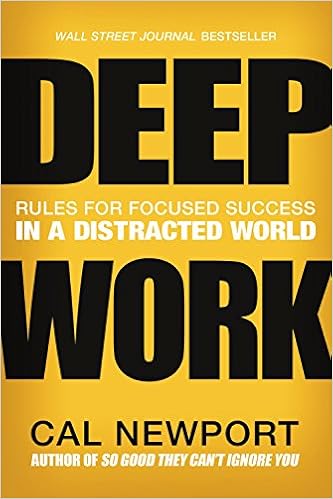
Although its subject is not the law, Cal Newport’s book Deep Work, Rules for Focused Success in a Distracted World is worth the read for legal professionals.

Newport defines Deep Work:

Professional activities performed in a state of distraction-free concentration that push your cognitive capabilities to their limit. These efforts create new value, improve your skill, and are hard to replicate.

He defines Shallow Work:

Noncognitively demanding, logistical-style tasks, often performed while distracted. These efforts tend to not create much new value in the world and are easy to replicate.

Newport theorizes that ‘knowledge workers’ (like attorneys) are losing their ability to perform Deep Work due to network tools (email, social media, web surfing and the like). Constantly sending and receiving emails erodes the ability to perform Deep Work.Image result for deep work images
He concedes that knowledge workers can’t devote 100% of their time to Deep Work: “a nontrivial amount of shallow work is needed to maintain most knowledge work jobs…the goal of this rule is taming shallow work’s footprint in your schedule, not eliminating it.”

A 2012 study found that knowledge workers spend 30% of their time on email. Newport views that as a bad thing. But I’m not sure it is for attorneys, which I’ll get into below.

Newport offers advice for draining the ‘shallows.’ He advocates limiting internet time and not allowing yourself to be distracted when performing Deep Work.

In other words, don’t take calls, check email or take a web surfing break. Also, don’t constantly check for new emails or messages.

He thinks it’s important to not use your phone for distraction/entertainment when doing things like waiting in line or killing time somewhere. He advocates dumping social media completely because it is designed to be addictive and doesn’t have much utility.

My Take:

Much in this book rings true. Deep Work is required for many aspects of litigation.

But I don’t think Newport recognizes the utility of email. He’s 35. He did not work in the pre-email world.

Email is a godsend for attorneys. Before email, lawyers traded phone calls for days and spent an inordinate amount of time on mail. As far as occupying time, email saves significant time for attorneys compared to communicating in the pre-email era. If email eats 30% of attorneys’ time, I’d guess it replaces letters and phone tag that used to eat 50% of attorneys’ time.

On the downside, I believe email increases stress and anxiety for attorneys. Before email, most work news arrived once per day with the morning mail delivery. Now, news appears in the inbox all day, everyday. I don’t know why this makes the day more stressful, I just know it’s true.

I concede that email is distracting. It’s easy for me to not use social media. Staying off the web is harder. I can do it if I want to.

But not constantly checking email is very hard. It’s just too tempting with electronic filing notices coming in all day and attorneys using email as their main form of communication.

Different practices require different amounts of Deep Work. Some practices require very little–some a lot.

Different attorneys approach it differently. Some are more adept and switching between cases in a day. Some attorneys are known for basically focusing on just one case for an entire work day. Everyone needs to figure out what works best for them.

It’s worthwhile for attorneys to think about how Deep Work fits into their practice and how they can perform it better. And by ‘better’ I mean both more efficiently and higher quality.

Twitter
Facebook
Email
LinkedIn

My Favorite Books I Read in 2017

I enjoyed writing the post on my favorite books of 2016 and am repeating it in 2017.

This is my list for the year, in the order that I read them. Note that the books weren’t necessarily released in 2017. I also updated the list throughout the year as a read the books instead of compiling as list at the end of the year.

To put it in context, I read approximately 40 books in 2017.

I read several books before one made the list. It was February before I hit one I consider 5-stars.

Here are this year’s favorites:

  • American Ulysses: A Life of Ulysses S. Grant– my first Grant biography. I under-appreciated him. From selling firewood in the streets of St. Louis to commander of the Union army and then President all in an 8 year span. Think about that the next time you pass a guy selling firewood on the side of the road. I’ve been a Sherman fan (who was way ahead of his time) since reading his memoirs in college. Now I see why Sherman was a Grant fan. After reading this, I now rank the big 4 like this: 1. Jackson; 2. Grant; 3. Sherman; 4. Lee. Jackson has a huge advantage by dying before Gettysburg, which was an unmitigated debacle for Lee. If Jackson makes it to 1865, he probably suffers defeats that drop his ranking.
  • The Futures– highly praised, I bought it because Amazon ran it on a kindle daily deal. It’s a novel about a couple who were Yale graduates moving to NYC in 2008 as the financial markets crashed. One worked for a hedge fund. The other had an affair. Having just finished the Grant book, I was prepared to dislike this novel. An author 20 years younger than me, Ivy Leaguers, NYC, investment bankers–not my cup of tea. But one of the joys of reading is when an author connects with you when you didn’t expect it. That happened here. I will buy Anna Pitoniak’s next book no matter what it’s about.
  • The Impossible FortressAnother novel, this one about teenagers in the 1980’s. How could I not love it? Reminds me of Ready Player One, but less plot and more character driven. I read this book at the end of March during a time period when I was struggling to get into the books I was reading. This book kind of made that problem worse, since I read it in a few days and had to return to my slog reads.
  • Armada– fun read by author of one of my favorite books: Ready Player One. Aliens invading earth is not an original plot, but still a fun read.
  • Al Franken, Giant of the Senate– Wow. This one really went up in flames. But worth the read just for the exchange with Lyndsey Graham about the latter’s presidential run. Makes you like Graham.
  • Elon Musk: Tesla, SpaceX and the Quest for a Fantastic Future– Great book about the man behind Tesla and SpaceX. Interestingly, he’s just as big of an a-hole as Jobs and Bezos. A good title of a book about the richest self-made men of the last 60 years would be “Warren Buffet and a Bunch of A-holes.”
  • When Genius Failed: The Rise and Fall of Long Term Capital Management– 2001 book about the 1998 collapse of the hedge fund Long Term Capital Management. The hubris of LTCM’s partners reminded me of lawyers in Mississippi (plaintiff and defense) during the boom of the late 1990’s and early 2000’s.
  • Dark Money the Hidden History of the Billionaires Behind the Rise of the Radical Right, by Jane Mayer- I postponed reading this for a year because I knew it would be depressing. And it was. You can’t understand modern politics at the national, state and sometimes local level without reading this book.
  • Black Edge: Inside Information, Dirty Money, and the Quest to Bring Down the Most Wanted Man on Wall Street, by Sheelah Kolhatkar- good luck sleeping at night with your retirement in the stock market after reading this book.
  • Hue 1968: A Turning Point for the American War in Vietnam, by Mark Bowden- a city battle in a war known for jungle fights. Bowden is a great writer.
  • Note: I hit a real dry spell for books making the list after reading Hue.
  • Two Kinds of Truth, by Michael Connelly, – Harry Bosch infiltrates an opioid pill ring and his brother Mickey Haller (Lincoln Lawyer) helps get him out of a wrongful conviction frame-up. This is my favorite Connelly book and I’ve read most of them.
  • The Rise of Theodore Roosevelt, by Edmund Morris- This is 2001 book that won a Pulitzer Prize. I’ve never read anything on T.R. because the turn of the century didn’t interest me much until I went on a Churchill binge. But this is a great book about an interesting man. If he was born 30 years later he might have been America’s Churchill. Both had overpowering personalities and had interesting lives from cradle to grave.

The two books that came the closest to making the list but didn’t were John Grisham’s Camino Island (unique, non-legal thriller and entertaining, but a little slow) and Hero of the Empire by Candice Millard (already knew the story from Churchill biographies).

Good reading.

Twitter
Facebook
Email
LinkedIn

My Favorite Books of 2016

Pretty slow on the legal front, so I’m going to do something new and list my favorite books that I read this year.

A caveat is that I view books as like ice cream–everyone’s taste is a little different. My favorites probably will not be your favorites. But most of us can agree on what are good books.

Here are my favorite books that I read this year:

  • Hillbilly Elegy– and there is a legal hook since it’s a memoir and the author went to law school;
  • When Breath Becomes Air– not a happy ending but a great book;
  • Rebel Yell (biography of Stonewall Jackson)– what a strange man; imagine a war breaking out and the weirdest dude in your law firm suddenly becomes the best general we’ve got;
  • The Perfect Pass- same author as Rebel Yell (S.C. Gwynne), which is why I read it, has a Mississippi connection–focuses on Bellhaven head coach Hal Mumme; my favorite football book in years–Gwynne can flat out write;
  • Shoe Dog– memoir by Nike founder Phil Knight; I reluctantly read this only because the average Amazon review was 5 stars with hundreds of reviews (that’s unusual); it was unbelievable; I’m not going to say it, but you know…fantastic read focusing on starting Nike;
  • Being Nixon– someone gave me The Last of the President’s Men last Christmas and it set me off on a Nixon and Watergate readgasm; I rate Nixon the most interesting president (but I haven’t read books on some interesting ones like Teddy Roosevelt and Lyndon Johnson); and
  • Dreamland- The True Tale of America’s Opiate Epidemic– dovetails the story of Oxycontin with the rise of heroin, which is very cheap and delivered like pizza in many American cities. An important topic given the growing heroin epidemic that is killing a lot of people in the country, especially young people.
Twitter
Facebook
Email
LinkedIn

Book Review: You Can’t Teach Vision, by John Morgan

You Can’t Teach Vision is John Morgan’s follow up to You Can’t Teach Hungry, which I favorably reviewed here. The sub-title of the book is the Twenty-First Century Law Firm, which Morgan continues to build. It could have been titled ‘what I’ve learned from thirty years in the law business.”

The book contains twenty-four short chapters on a range of topics related to law firms. In the last chapter, fittingly titled ‘Windows Open, Windows Close’, Morgan opens up about what set his fanatical drive in motion. can't teach vision

Growing up in Lexington, Kentucky both Morgan’s parents were alcoholics and his home life “was a real shit show.” As a young child Morgan broke a tooth. At the dentist’s office his father told the dentist to pull the tooth because they could not afford the $50 price tag for a root canal. Morgan vowed that money would never again block something he needed and started working as a paper boy.

Morgan turned out to be an entrepreneur and ended up helping support his family. The motivation and drive that started as a child apparently continues to drive Morgan today. If I had made enough money to buy $25,000 in Amazon stock every month I would have gone to the house by now. Morgan is obsessed with getting it to the next level.

How many people had heard of Morgan & Morgan ten years ago? Today, it’s the largest plaintiff law firm in the country and continues to grow. Like it or not (and I don’t), the large law firm is the future of plaintiff law.

One of the biggest changes in the profession since I have been practicing is the takeover of complex litigation by large plaintiff firms. The light bulb went on for me on this topic in 2010 while I was researching this post on the steering committee for the BP Oil Spill. Aggregation of big cases in MDL’s has made solo and small firm low-volume/ large-case plaintiff lawyers like me dinosaurs. It’s a model that worked much better in the past than the present and future.

Morgan has done it bigger and faster than anyone.

That’s not to say that I agree with Morgan on everything. He loves being constantly connected and likes lawyers who send out emails at 2:00 a.m. I don’t like how people have become tethered to their devices and expect immediate responses to routine emails.

As for 2:00 a.m. emails, for me, they are always a mistake. I have trouble staying asleep and am up in the middle of the night a lot. One of the most frustrating things about it is the fact that my brain is not in working shape. I can write down a bunch of ideas or even send out some emails. But when I read them the next day, they almost never are great thoughts. Sort of like no matter how awake I felt, part of my brain was still asleep.

Plus, whenever I see a work email that was sent at 2:00 a.m., I think that the sender must be on drugs or something.

Similarly, I read a lot and usually have 2-4 books going at a time, but I can’t get quality reading done in the middle of the night. I think this is why I, and many other insomniacs, end up watching TV in the middle of the night. The Bloomberg business channel is my go-to middle of the night program. It’s Goldilocks: interesting enough to hold my attention, but boring enough to put me to sleep.

Morgan has an engaging writing style and sense of humor that makes his books quick reads. Along the way he answers many questions people have about Morgan & Morgan, like their advertising budget is up to $40 million and last year 60,000 people hired the firm.

There is a lot of wisdom in the book and I highly recommend it. It reminds me of Rick Friedman’s on Becoming a Trial Lawyer more than Morgan’s previous book. Both are must reads for plaintiff lawyers. Non-plaintiff lawyers who think about the business side of the profession would probably also find the books interesting.

Twitter
Facebook
Email
LinkedIn

Book Review: Don’t Eat the Bruises, by Keith Mitnik

Keith Mitnik has a job many trial attorneys would envy. As Senior Trial Counsel for the nation’s largest personal injury firm (Morgan & Morgan), Mitnik gets to try cases that other lawyers work up. Mitnik tries 1-3 cases per month. don't eat the bruises

Don’t Eat the Bruises is Mitnik’s perspective on what works from the plaintiff’s side of the courtroom. The book is not a comprehensive trial practice book like McElhaney’s Trial Notebook. It’s also not a book that offers a system, like Reptile. Instead, the book suggests approaches to incorporate into the practitioner’s existing trial system. While the book would be helpful for beginners, lawyers probably need to already have trial experience to fully grasp the reasoning behind all of Mitnik’s techniques.

The first third of the book covers voir dire. Mitnik’s focus is on how to identify and strike biased jurors in the age of tort reformed juries. His techniques are both timely and practical. Plaintiff attorneys who use them will have an easier time identifying defense-biased panel members.

Mitnik devotes other sections to opening, the evidence phase (direct and cross), closing and dealing with the burden of proof. The section on closing arguments suggests a system to help prepare for closing during the trial so that it’s easier to formulate your argument at the conclusion of trial. This is helpful because lawyers are exhausted at the end of long trials. I’ve been underwhelmed by my own closings and am going to try Mitnik’s approach in my next jury trial.

This is a good book that belongs on the plaintiff lawyer’s bookshelf next to Rules of the Road and Damages.

Twitter
Facebook
Email
LinkedIn

Book Review: Typography For Lawyers, 2nd Ed., by Matthew Butterick

You know you are a law geek when you get excited reading a book called Typography for Lawyers.

Guilty.

Matthew Butterick’s book first reviewed on this site in 2011 is now out with a second edition. The first edition has a perfect 5 of 5 customer review rating on Amazon with 100 reviews as of this writing.

The new edition includes 20 pages of new material. The new material addresses topics including email, footnotes, presentations, contracts, court opinions and new font recommendations. typography for lawyers

You can really get lawyers worked up discussing footnotes and fonts.

This is a book that should be on all legal professionals’ bookshelf.

Appearance matters in persuasive writing. A document that looks better is easier to read and comprehend. This book teaches lawyers how to make their documents look better.

There are not many books for lawyers that should be considered indispensable. This is one of them.

I’m not seeing the second edition on Amazon yet, but you can buy it here.

Twitter
Facebook
Email
LinkedIn

Book Review: Stand Up That Mountain, by Jay Erskine Leutze

Stand Up That Mountain by Jay Erkskine Leutze is the true story of a protracted legal battle to save an area adjoining the Appalachian Trail in North Carolina from development as a gravel mine for the next 100 years.

Here is a description of the book:

LIVING ALONE IN HIS WOODED MOUNTAIN RETREAT, Jay Leutze gets a call from a whip-smart fourteen-year-old, Ashley Cook, and her aunt, Ollie Cox, who say a local mining company is intent on tearing down Belview Mountain, the towering peak above their house. Ashley and her family, who live in a little spot known locally as Dog Town, are “mountain people,” with a way of life and speech unique to their home high in the Appalachians. They suspect the mining company is violating North Carolina’s mining law, and they want Jay, a nonpracticing attorney, to stop the destruction of the mountain. Jay, a devoted naturalist and fisherman, quickly decides to join their cause.

So begins the epic quest of “the Dog Town Bunch,” a battle that involves fiery public hearings, clandestine surveillance of the mine operator’s highly questionable activities, ferocious pressure on public officials, and high-stakes legal brinksmanship in the North Carolina court system. Jay helps assemble a talented group of environmental lawyers to contend with the well-funded attorneys protecting the mining company’s plan to dynamite Belview Mountain, which happens to sit next to the famous Appalachian Trail, the 2,184- mile national park that stretches from Maine to Georgia. As the mining company continues to level the forest and erect the gigantic crushing plant on the site, Jay’s group searches frantically for a way to stop an act of environmental desecration that will destroy a fragile wild place and mar the Appalachian Trail forever.

It’s a great story. This occurred around the turn of the millennium in Avery County North Carolina. For those familiar with the AT, the proposed mine was located about 1 mile from Hump Mountain, one of the iconic Southern Balds on the AT.

The mine owner pulled a fast one to conceal the development of the mine until well after construction began. Rather than provide notice to adjacent land owners, the mine owner pulled the permit area 50 feet inside the property lines and gave notice to…..get this….himself. It was a ridiculous ploy. And he almost got away with it.

The AT crossing Hump Mountain

The adjoining landowners, environmentalists, Appalachian Trail Conservancy and hiking community learned of the debacle almost after it was too late and eventually rallied to stop it behind the tireless work of Jay Leutze. The competing interests make for a colorful cast and an outcome that remains in doubt until a ruling by the North Carolina Court of Appeals.

The battle lasted for years. The fourteen year old Ashley graduated by the time it was over.

The good guys won in the end. But especially as a litigator, I know it could have easily gone the other way.

I took the photo to the right hiking over Hump Mountain in June 2014. It is a spectacular area. I’m happy to say that I did not see a gravel mine.

Twitter
Facebook
Email
LinkedIn